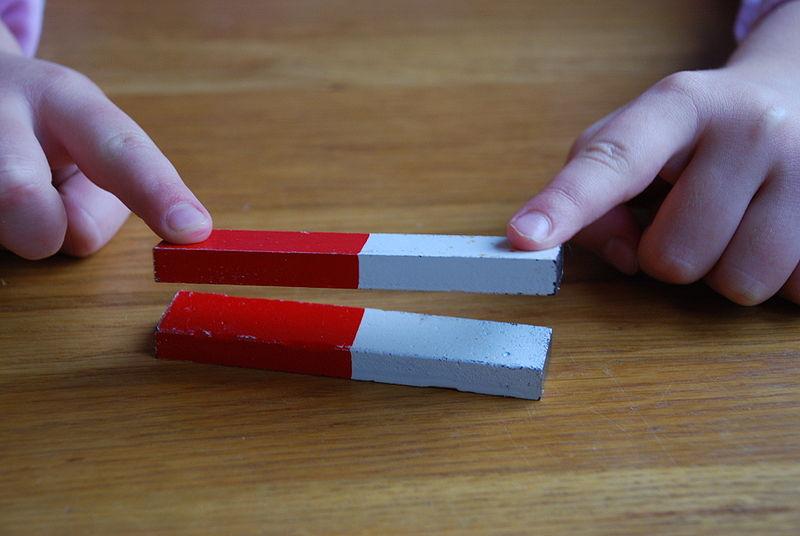
As a child, I was always fascinated by magnets: why two ‘south’ or ‘north’ poles would never ever click with one another. It took a while to understand the reasoning behind it. And as with that, there’s a real wisdom behind this rule which prevents two saakin letters from meeting…
This rule has been looked at from a number of angles, however it was never formally mentioned on the site.
Man‘ iltiqaa’ al-saakinayn[1]: preventing two saakins from meeting (following one another) is that rule which is sometimes taken for granted although the Arabic language heavily endorses it.

The rule states: if a word ending with a madd letter precedes a word which starts with a sukoon, the madd letter is dropped so as to avoid/prevent two saakins from meeting; this of course only applies when continuing recitation. In replacement of the madd letter, its respective diacritic takes places (kasrah for yaa, fat-ha for alif, dammah for waaw). Here, it is important to note that madd letters in the Arabic language do not have a diacritic. They are considered to be saakin, and hence why this rule exists.
Let’s look at some examples,

Read as:
when continuing: wa qaala-l-hamdu lillahi ( و قالَ الحمد لله )
when stopping: wa qaalaa .. alhamdu lillahi ( و قالا .. الحمد لله )

Read as:
when continuing: ghayra muhilli-s–saydi ( غير محلِّ الصيد )
when stopping: ghayra muhillee .. as–saydi ( غير محلّي .. الصيد )

Read as:
when continuing: aamanu-t-taqu-llaha ( ءامنُ اتقواْ لله )
when stopping: aamanoo .. ittaqu-llaha ( ءامنو .. اتقواْ لله )
Previously we noted this rule indirectly, when it occurs with hamzatul wasl (said under “circumstance 3” and on).
Also, the hamzatul wasl post contained a brief mention of this rule. Found where quoted: “Finally, I want to give an ex..”
That’s all for this post. I hope it wasn’t too complicated to repel you away from the upcoming tajweed rule! 😉
Resources Link:
– Sukoon [Gateway To Arabic: page 48]
– Short vowels [Gateway To Arabic: page 23, 24]
– Long vowels [Gateway To Arabic: page 45, 46]
– Read more about rules of stopping [Tajweed Basics: Foundations and More: page 15]

Note, these documents are found on the resources page.
[1] منع التقاء الساكنين
 Tajweed Me
jazaakumullahu khayr.
Jazakumullahu Khayran for this great explanation,but there is just a mistake in the example ( ءامنن اتقوا الله )it shouldn’t be with two Noons, it should be only one Noon with Damma, so that learners don’t get confused
Wa iyyakm, and thank you for pointing that out. It has now been fixed.