NOTE: if you are new to the website, please click here for a brief guide.

The time it takes to repair and re-connect depends on how frequent you undergo a check up. Remember to revisit your heart’s checklist [emotion, faith, intentions, etc] occasionally in order to shorten the time it needs to wholeheartedly repent and re-connect with Allah. Keep in mind though, this isn’t the only connection you’ll need to take care of…..

Al-Madd Al-Silah[1]: the connecting prolongation directly relates to the grammatical rule regarding the [possessive] pronoun that represents a third party of male gender. This [possessive] pronoun is simply the addition of the letter haa ( هــ ) at the end of a word. Therefore the referred third party is not part of the original make up of the word. At the end of a word, the letter haa looks like this ( ــه ).
The purpose of this madd is to lengthen the dammah in order for it to sound like a waaw (و) or to lengthen the kasra to sound like a yaa (ي). Explanation below.
Al-madd al-silah separates into two types: kubra (longer) and sughra (lesser).
Al-madd al-silah al-sughra (the lesser connecting prolongation) has the following conditions:
– the madd becomes void if the reciter stops at the end of the word, sounding a haa saakin, i.e. you must continue to the next word in order to sound this madd
– the haa on the end of the word must not be part of the original word
– the haa sits between two voweled letters (two letters that have a diacritic on them – neither of the two can have a sukoon)
– the haa is not followed by a hamzah ( ء or أ )
– the haa is voweled with either a dammah or a kasra, but NOT a fat-ha
– the dammah or kasra is lengthened for 2 counts only
Al-madd al-silah al-kubra (the longer/larger connecting prolongation) has the following conditions:
– the madd becomes void if the reciter stops at the end of the word, sounding a haa saakin, i.e. you must continue to the next word in order to sound this madd
– the haa on the end of the word must not be part of the original word
– the haa sits between two voweled letters (two letters that have a diacritic on them – neither of the two can have a sukoon)
– the haa must be followed by a hamzah ( ء or أ )
– the haa is voweled with either a dammah or a kasra, but NOT a fat-ha
– the dammah or kasra is lengthened for 4 -5 counts
Conditions 1, 2, 3, and 5 are the same for kubra and sughra.
Examples of al-madd al-silah sughra:
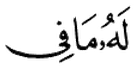
lahuu maa fee
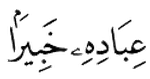
‘ibaadihii khabeeraa
 kitaabahuu waraa’a
Examples of al-madd al-silah kubra:

maalahooo akhladahu

haathiheee eemaanan
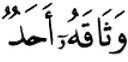
wathaaqahuuu ahadun
So did you notice anything similar throughout the examples?
Yes, something other than the fact they are all madd silah… 🙂
Did you notice a little waaw and a little yaa after the [possessive] pronoun haa?
These little symbols make this madd too easy!
Notice on the madd silah kubra, all the little symbols have a madd above them).
Notice on the madd silah sughra, all the little symbols don’t have anything above or below!
As you read, just do a check. Does this haa have a little waaw or yaa after it? If so, then know it’s madd silah.
Does this little waaw or yaa have a madd squiggle on top? If so, then it’s a silah kubra, and stretch your yaa or waaw for 4 – 5 counts.
Simple! Right?
Before I close off this post, I want to note that there are some exemptions.
Two exemptions for silah sughra are as follow:
Here there is no madd although all the madd silah sughra conditions are met:
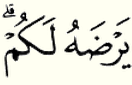 yardahu lakum
Here there is a madd although not all the madd silah sughra conditions are met (there is a harf saakin before the haa):
 feehii muhaanan
Note 1: there is a third case where the possessive pronoun haa is feminine. In this case, madd silah is still done:
 haathihii tathkiratun
Note 2: in case you wanted an example of when the haa is part of the original makeup of a word, here it is below:
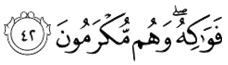 fawaakihu wa hum mukramoona
All the conditions of madd silah are present (except the haa being unoriginal). It is because of this, that no madd silah is said.
Resources Link:
– ‘Jadwal Al-Mudood’, eighth madd listed
-Short and long vowels [Gatway To Arabic: pages 21-23; and 44-47]
– ‘Tajweed Basics Foundations And More’ covers a range of mudood
Note, these documents are found on the resources page.
Related Posts: Ahkaam Al-Madd – Al-Madd Al-Tabee’ee – Al-Madd Al-Waajib Al-Mutasil – Al-Madd Al-Jaa’ez Al-Munfasil – Al-Madd Al-’Iwad – Al-Madd Al-Badal – Al-Madd Al-Leen – Al-Madd Al-‘Aarid Lil Sukoon – Al-Madd Al-Laazim: Kalimee – Al-Madd Al-Laazim: Harfee.
[1] Al-Madd Al-Silah Al-Kubra wa Al-Sughra: المد الصلة الكبرى و الصغرى
 Tajweed Me
have just read this section and it made perfect sense to me, the detail is just right, jazakallah for your help in making me understand, I hope you continue your good work.
Wa iyyaki. I’m really happy you’ve understood it well. It just makes it all the more worth continuing this blog with sincerity 🙂
Assalamalaykum. I had a query relating to the word fa’woo in this ayah http://quran.com/18/16. Which rule applies to this word? Does the madd extension have to be 4 or 2 is alright for this word. Jazaki Allaahu Khair.
Assalamualaikum,
JazakAllahu Khairan! May Allah put barakah in your time and knowledge!
Alhamdulillah I am just gaining from this in December 12 2024,allahuakbar what a bĺessing
Assalamu Alykum Wa Rahmatullohi Wa Barakatuhu.
Wa alaykum asalam wa rahmatullahi wa barakaatuh,
Madd Al-Silah only applies to the ‘Ha’ al-Kinayah (the Pronoun Ha). This is an ‘extra’ letter added to the end of a word to mean ‘his’ or ‘him.’ In these cases, if you remove the Ha (ــه), the base word still makes sense. It is a suffix used to show possession.
Eg. base word is kitaab (book). Add the suffix ــه and it becomes kitaabuh (his book).
In the cases where the ‘Ha’ is part of the original word, it means that that word naturally ends with this letter. The example I provided is Fawakih (فواكه), meaning ‘fruits’. The ‘Ha’ here is not a pronoun meaning ‘his’; it is just the last letter of the word. Because it is part of the original building blocks of the word, we do not perform Madd Silah, even if it falls between two voweled letters.
I hope this clarifies it for you. Wa iyyakum!